


Categories
Vendor
Availability
Price
-
from
to
Rakes and tedders are key machines on every farm involved in growing grass and forage crops. Their primary task is to facilitate the hay harvesting process and ensure its high quality by properly preparing the windrows. Rakes are used to gather the mown material into even windrows, enabling easier and more efficient baling or collection. Modern rakes and tedders are equipped with advanced technologies, such as ground-following systems, adjustable working widths, and the option to mount them on the tractor's front or rear three-point linkage. Thanks to this, these machines can operate effectively even on difficult and uneven terrain, minimizing material losses.
Rotary tedder-rake 4.0 m
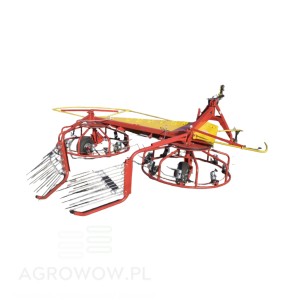
- Manufacturer: Pomarol
- Catalogue number: PML40PZ
- Manufacturer's name: Rotary tedder-rake
- Model: Z 518
- Working width: 4000 mm (4.0 m)
- Transport width: 3000 mm (3.0 m)
- Height: 1350 mm
- Weight: 470 kg
- Transmission type: Belt transmission
- Number of rotors: 2
- Tine type: Double tines
- Number of tines: 16
- Tractor power requirement: 40 HP
Availability: Dostępny
Multifunctional Combined Rake-Tedders – Efficient Forage Cultivation in a Single Pass
Combined rake-tedders are indispensable machines on farms engaged in harvesting grass and forage crops. Their primary function is to combine two key processes – tedding and raking – which significantly speeds up windrow preparation and improves forage quality. In the first operating stage, the machine gently spreads the mown material, accelerating the drying process and preventing mold-related issues. Then, in raking mode, it forms uniform windrows, facilitating subsequent baling or collection. Modern combined rake-tedders are equipped with advanced technologies, such as ground-following systems, adjustable working widths, and the option to mount them on the tractor's front or rear three-point linkage. Various types of combined rake-tedders are available – including rotary, belt, tape, or basket models – each possessing unique features tailored to specific working conditions.
Front Hitch Rake – Time Savings and Maximum Operating Efficiency
The front-mounted rake is an innovative solution for farmers seeking efficiency and time savings during field operations. Mounting the rake on the tractor's front three-point linkage (3-point hitch) enables several operations to be performed simultaneously in a single pass, significantly increasing productivity. This allows hay raking to be combined with other tasks, such as baling or windrow collection using a machine mounted on the rear linkage. Such a solution is particularly beneficial during periods of intensive field work, when every saved minute counts, as well as in situations where weather conditions force rapid action. Front-mounted rakes feature a compact design and are engineered to provide the operator with excellent visibility and control over the machine's operation. Additionally, shifting the center of gravity to the front of the tractor improves its stability and traction, which is crucial, especially on uneven and sloping terrain.
Lightweight and Efficient 4-Wheel Rake – Reliability for Small and Medium-Sized Farms
The 4-wheel rake is a popular and highly valued solution among farmers seeking efficient and economical equipment for raking hay and straw. Its name comes from its design, which utilizes four finger wheels, also known as rotors, equipped with flexible spring tines. During operation, these tines gently lift and move the plant material, forming uniform windrows ready for subsequent collection or baling. Rakes of this type are particularly recommended for small and medium-sized farms, where the price-to-quality ratio and simplicity of operation are essential. The advantage of the 4-wheel rake is its lightweight design, which allows it to work with lower-horsepower tractors frequently found on smaller farms. Furthermore, the simplicity of the mechanism translates into lower operating costs and reduced susceptibility to breakdowns.
The Rake – Streamlining Your Harvest
The rake is a general term for various types of agricultural machinery used to gather mown plant material, such as hay, straw, or green forage. It is an essential piece of equipment on any farm involved in bulk forage production or cereal cultivation. Rakes enable the formation of uniform windrows, which facilitates subsequent tasks related to baling, harvesting, or transporting the material. There are many types of rakes available on the market, including rotary, wheel, belt, conveyor, or front-mounted models, each with its own specific applications and advantages. Choosing the right rake depends on the farm's size, available tractor equipment, crop types, and terrain topography. Modern rakes are equipped with advanced adjustment systems, allowing for the customization of working width, operating height, and the speed of the working components.
Belt Rake-Tedder – A Modern Solution for Farmers Focused on Forage Quality
The belt rake-tedder is a multifunctional agricultural machine that combines the benefits of a tedder and a rake, utilizing an innovative conveyor belt system. This machine enables both the spreading of freshly mown material to accelerate its drying process and the raking of hay or straw into uniform windrows to facilitate subsequent collection. Consequently, the belt rake-tedder significantly increases field work efficiency while saving time and resources by eliminating the need to purchase and operate two separate machines. The conveyor belt system in this machine ensures gentle handling of the plant material, minimizing damage and the loss of valuable, nutrient-rich leaves. This is particularly crucial when harvesting high-quality forage for livestock.
Uniform Drying Thanks to the Belt Tedder
The belt tedder is a modern agricultural machine designed for the efficient turning and spreading of hay and other plant materials after mowing. By utilizing a conveyor belt system equipped with working tines, the belt tedder gently lifts and scatters the material across the field surface, accelerating the drying process. This solution ensures an even distribution of hay, which is crucial for preserving its quality and nutritional value. When choosing a tedder, it is important to consider the robustness of the design, the quality of the materials used, and the availability of servicing and spare parts. Regular maintenance and proper operation of the machine will ensure its reliability and long lifespan. Combined with the benefits of its use, this will ultimately translate into better economic results for the farm.
Lightweight and Effective – The Rotary Tedder for Hay
The rotary hay tedder, colloquially known in Poland as the "spider" tedder and often related to wheel or rotary raking designs, is a popular piece of agricultural equipment used for spreading and turning hay after mowing. Its distinctive design consists of several arms equipped with spring tines that rotate around a central axis, gently lifting and scattering the plant material across the field. This ensures that the hay drying process is faster and more uniform, which is crucial for maintaining the high quality of the harvested forage. Rotary tedders are valued for their simplicity, reliability, and low operating costs. Their lightweight construction allows them to work with lower-horsepower tractors, which is essential for smaller farms. In an era of increasing demands regarding forage quality, the rotary tedder is becoming an indispensable asset for any modern farm.
Przewracarka karuzelowa gwarancją szybszego suszenia i lepszej jakości paszy
Przewracarka do siana karuzelowa do efektywnego roztrząsania i przewracania siana oraz zielonek na polu. Jej konstrukcja opiera się na obracających się rotorach wyposażonych w palce sprężynowe, które podczas pracy unoszą i rozrzucają materiał roślinny. Dzięki temu proces suszenia przebiega szybciej i równomierniej, co ma kluczowe znaczenie dla zachowania jakości pasz objętościowych. Przewracarki karuzelowe są szczególnie polecane dla gospodarstw o większej skali produkcji, gdzie liczy się wydajność i szybkie tempo prac polowych. Dostępne są w różnych szerokościach roboczych i konfiguracjach, co pozwala na dopasowanie maszyny do indywidualnych potrzeb gospodarstwa. Nowoczesne modele wyposażone są w systemy regulacji prędkości obrotowej rotorów, kąta nachylenia palców oraz mechanizmy kopiowania terenu, co pozwala na precyzyjne dostosowanie pracy maszyny do warunków polowych i rodzaju zbieranego materiału.
The Rotary Tedder – A Guarantee of Faster Drying and Better Forage Quality
The rotary hay tedder is designed for the efficient spreading and turning of hay and green forage in the field. Its design is based on rotating rotors equipped with spring tines, which lift and scatter the plant material during operation. This ensures that the drying process is faster and more uniform, which is crucial for preserving the quality of bulk forage. Rotary tedders are particularly recommended for large-scale farms where efficiency and a fast pace of field work are paramount. They are available in various working widths and configurations, allowing the machine to be tailored to the individual needs of the farm. Modern models come equipped with systems for adjusting rotor speed, tine angle, and ground-following mechanisms, enabling precise adaptation of the machine's performance to field conditions and the type of harvested material.
An Efficient Machine for Uniform Windrows – The Belt Merger
The belt merger is a modern agricultural machine designed to gather mown plant material, such as hay or straw, utilizing a conveyor belt system. Unlike traditional rakes, belt models employ transport tapes equipped with tines or bars that gently lift and transfer the material to form uniform windrows. Consequently, the belt merger ensures high-quality raking while minimizing crop losses and damage, which is particularly important when harvesting top-quality forage for livestock. These machines feature high efficiency and operating precision, while adjustable belt speeds and working heights allow the performance to be customized to current field conditions and the type of harvested material. Belt mergers are highly recommended for farms focused on producing premium-quality forage, where preserving the nutritional value and structure of the plant material is critical. Additionally, thanks to their design, belt mergers can operate in various terrain conditions, and the ground-following system ensures consistent performance even on uneven fields.